An alarm system is only as good as the people watching it. Michigan Security Systems connects your burglar, intrusion, fire, and environmental alarms to a UL-listed central station — trained operators who respond in seconds, verify the threat, and dispatch police or fire, 24 hours a day, every day of the year.
We monitor burglar and intrusion alarms, fire and smoke, carbon monoxide, panic and hold-up buttons, and environmental sensors — with video verification to cut false dispatches. Every system is installed and connected by our own W-2 technicians and backed by fast, professional response.
Every business owner knows the fear: an alarm goes off at 2 a.m. and no one hears it. An unmonitored alarm just makes noise. Professional 24/7 monitoring means trained operators see the signal the instant it fires, verify it, and get police or fire moving — whether you're asleep, away, or across the country.
24/7 monitoring is a core layer of a complete commercial security system for your Michigan business.
Break-ins, fires, and equipment failures don't wait for business hours. Central-station monitoring watches your alarms around the clock, so a burglary, a fire, or a frozen pipe triggers an immediate, professional response instead of sitting undiscovered until morning.
Every signal is a decision point: real event or false trip, at any hour of the day or night. A siren alone can't tell anyone what's actually happening inside your building. Central-station monitoring can — putting a trained operator on every alarmed, verified checkpoint.
An alarm that just sounds a bell on the wall gets ignored by neighbors. The value is in the response — who gets notified, in what order, and who dispatches police or fire. That's the monitoring work most installers skip.
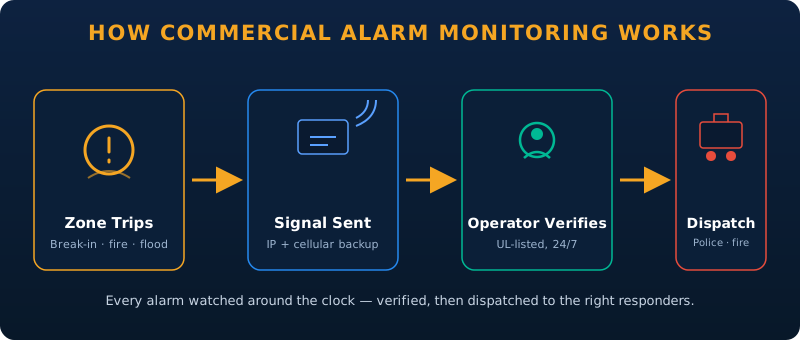
How it works. An alarm triggers. The signal travels instantly to the UL-listed central station, where a trained operator sees the event, checks any connected video to verify it's real, follows your response plan, and dispatches police or fire — typically within a few minutes, while notifying your contacts.
We're an integrator, not a single-line dealer. We connect your alarm to a UL-listed central station that fits your building and budget — not the one we're contractually obligated to push.
| Platform | Best Fit | Key Capabilities | Connection |
|---|---|---|---|
| Burglar & Intrusion | Break-ins, unauthorized after-hours entry | Verify & dispatch police in minutes | Every commercial site |
| Fire & CO | Smoke, heat, carbon monoxide | Dispatch fire department immediately | Life-safety compliance |
| Panic & Hold-Up | Robbery, workplace threats | Silent priority dispatch | Retail, banks, clinics |
| Environmental | Freeze, flood, power & temperature | Alert you before damage spreads | Warehouses, restaurants, labs |
An honest note on “self-monitoring” apps. A phone alert is better than nothing — until you're in a meeting, on a plane, or asleep, and no one dispatches help. What a UL-listed central station adds is a trained human watching 24/7, video verification to reduce false dispatches, and a direct line to first responders that a push notification simply can't match.
An unmonitored alarm just makes noise. That's a deterrent at best. Because we install alarms, cameras, and access control across Michigan every day, we connect your alarm to professional monitoring and to video verification — one system that actually brings help, not just a siren.
A zone trips, and your Axis, Hanwha, or Digital Watchdog camera gives the operator a live look — the sensor location plus the wider scene — so dispatch is never based on a blind signal.
On PDK or CDVI controlled doors, the alert can be correlated with who badged into that wing. Useful in colleges, hospitals and workplaces where access is credentialed.
Calls ring the front desk, the security office, or a staff distribution list on their phones — not a hallway alarm that broadcasts the event to the whole school and teaches students to game it.
We're a Bogen and Aiphone dealer. Where a facility wants alarm events tied into overhead paging or emergency notification, that path already exists in our stack.
Location and time-of-day heat maps show whether the program is working. That data is what justifies phase two — and what a superintendent needs at the next board meeting.
Zero subcontractors. The technician who wires the panel works for us, the tech who programs the communicator works for us, and the person who answers when it false-alarms in November works for us.
Most owners assume monitoring means one panel calling one phone number. A modern central station is far more flexible — a single event can notify a manager, a keyholder, and dispatch at once, so whoever is available answers the door.
Commercial alarm monitoring scales cleanly from a single storefront to an entire multi-building portfolio on one account. You can start with the site that matters most and add locations over time — every station you add works alongside the ones already in place, with no rip-and-replace.
Worth knowing:rising break-in losses and insurance requirements mean facilities want a verified response the moment a zone trips — not a voicemail the next morning.
A single monitoring account manages every site from one dashboard — ideal for schools, hospitals, and property managers — from a single entrance to dozens across a campus. IP platforms that scale across many doors tend to fit multi-building facilities best.
For phased projects, we design the network and station layout up front so later additions are simply plugged in — no rip-and-replace, no wasted spend on a system you will outgrow.
Monitoring accounts that cover many sites and integrate with cameras and access control tend to fit multi-building facilities best.
In practice: a retail store gets an instant burglary response after hours, a warehouse gets a fire signal dispatched in minutes, and a restaurant gets an alert before a walk-in freezer failure spoils inventory — all watched from one UL-listed central station.
We walk the building with your team and identify the entrances that actually matter — main lobby, shipping, after-hours doors, gates. Door locations, network drops, power, and how your staff will answer all get recorded.
One location or a hundred, one alarm type or all of them, based on your business and your budget. You get straightforward monitoring pricing and a real response plan — not a mystery bill and a generic script.
We work with your team on the call list, passcodes and dispatch priorities before a single signal is armed. We define who gets alerted, in what order, and what happens next. This step is where most failed deployments actually failed.
Mounted, cabled, configured and labeled by MSS employees. Summer and after-hours scheduling for occupied school buildings is standard for us.
We test every zone end to end and tune out the nuisance trips — a loose contact, an HVAC draft, a delivery door. Clearing those in the first weeks is what keeps your team trusting the alerts in month six.
Your administrators learn the console, the app and the reporting. Then we stay on the other end of the phone — same company, same number, for the life of the system.
A monitored alarm with a bad call list wastes the minutes that count. We build and maintain your response plan — contacts, verification steps, and dispatch rules — so when an alarm fires, the operator acts immediately and correctly, not after guessing.
From a single storefront to a campus of buildings, 24/7 monitoring gives every kind of Michigan facility a verified response to break-ins, fire, and equipment failures — here's where it earns its keep.
Monitor after-hours intrusion, fire and medical-gas or freezer alarms, and get a verified dispatch to protect patients and controlled areas around the clock.
Verify drivers and vendors at shipping docks and gates before releasing a door, and give office staff eyes on every plant entrance from one station.
Manage lobby, package-room, and after-hours entry across many units — residents and staff answer the door from a phone or in-unit station.
Monitor city halls, libraries, DPW yards, and public-safety buildings — intrusion, fire and environmental signals watched 24/7 with documented response.
Give staff a clear video-and-audio view of everyone at the main entrance, with simple in-unit answering that residents actually find easy to use.
Pair alarm monitoring with gate and perimeter sensors so a breach at the fence line is caught, verified against cameras, and dispatched without anyone on site after hours.
As a Michigan commercial alarm monitoring provider and full-service integrator — not a single-line dealer — we connect and service every major commercial alarm panel to a UL-listed central station. We recommend the right brand for your building, your network, and your compliance needs — not whichever line we're locked into. The commercial alarm panels and monitoring platforms we most often connect to central-station monitoring include:
A note on NDAA compliance: for government, municipal, and federally-funded facilities, we prioritize NDAA-compliant platforms like Aiphone and 2N (owned by Axis Communications). If your project has compliance requirements, we'll spec equipment that meets them — and tell you plainly which brands do and don't qualify.
A representative sample of the commercial alarm and monitoring platforms we work with — not a complete list. We are brand-independent and connect the right system for your project.
Find out where you stand with our free Security Plan Builder — a readiness score, your biggest gaps, and a real plan to close them. About 3 minutes, no email required.
Build my free security plan →Headquartered in Mount Clemens with branch offices in Wixom and Milford — serving school districts, hospitals and employers throughout Michigan, Ohio and Indiana.
Searching for a commercial alarm monitoring company near you in Michigan? Michigan Security Systems installs and services commercial alarm monitoring, UL-listed central station monitoring, burglar and fire alarm monitoring, intrusion detection, and video-verified alarm response for businesses across Metro Detroit, Ann Arbor, Lansing, Flint, Grand Rapids, and the surrounding communities of Macomb, Oakland, and Wayne counties. Whether you need a single storefront connected to a UL-listed central station or a campus-wide monitoring account across dozens of buildings, our licensed Michigan technicians handle the setup, testing, and support — never subcontractors.
Sterling Heights, Warren, Clinton Township, Shelby Township, Chesterfield, New Baltimore, Romeo, Utica, Mount Clemens and surrounding districts.
Troy, Novi, Southfield, Rochester Hills, Farmington Hills, Royal Oak, Auburn Hills, Pontiac, Milford, Wixom and surrounding districts.
Detroit, Livonia, Dearborn, Canton, Plymouth, Westland, Taylor, Northville and surrounding districts.
Most integrators your district calls will subcontract the install. You’ll get a company name on the quote and a stranger on the roof — and when the alarm false-trips in November, you’ll find out that company doesn’t employ the person who mounted it.
We don’t work that way, and we never have. The technician who walks your building, the one who wires and programs the panel, and the one who picks up when you call in month six all have Michigan Security Systems on their paycheck. That’s been the rule here since 2000.
It’s also why we schedule school work around your building — summers, evenings, and breaks — rather than around a subcontractor’s availability.

Our own crew, our own truck. On site at a Michigan facility — the same crew that handles your cameras, access control and alarm monitoring.
We'll walk it, give you an honest monitoring plan and a quote your office can act on — and if central-station monitoring isn't the right spend for your situation, we'll tell you that too.
Michigan Security Systems — Mount Clemens · Wixom · Milford — Serving Michigan, Ohio & Indiana since 2000
Every monitored commercial alarm we install includes:
Fill out the form below and a Michigan Security Systems specialist will contact you within one business day to schedule your free, no-obligation site assessment. We serve businesses throughout Michigan, Ohio, and Indiana.
Michigan Security Systems · 586-466-4490
Macomb County, Michigan
Wixom, MI · Milford, MI
Michigan · Ohio · Indiana
Mon–Sat: 8:00 AM–7:00 PM
24-Hr Emergency: 1-800-941-6797