Student vaping happens in the one place a camera can't go — the restroom. Michigan Security Systems installs and integrates commercial vape detectors that give your staff a silent, real-time alert the moment it happens, without putting a lens anywhere it doesn't belong.
We install all major platforms — HALO Smart Sensor, Zeptive, Verkada, Triton and Soter — and tie them into the cameras, access control and paging you already own. Every device is mounted, networked and commissioned by our own W-2 technicians.
Every Michigan principal already knows where the vaping is happening. The problem has never been identifying the room — it's proving it, staffing it, and responding to it fast enough to matter.
The University of Michigan's Monitoring the Future study — the national benchmark for adolescent substance use — has tracked the rise in high school nicotine vaping for years. Michigan districts are citing U-M's own research in their grant applications.
Restrooms and locker rooms are the highest-risk vaping areas in any school building and the one place video surveillance is off the table. Vape sensors close that blind spot without recording video or audio.
A sensor that alerts nobody, or alerts everybody, gets ignored by February. The value is in the response workflow — who gets the alert, on what device, with what camera view attached. That’s the integration work.
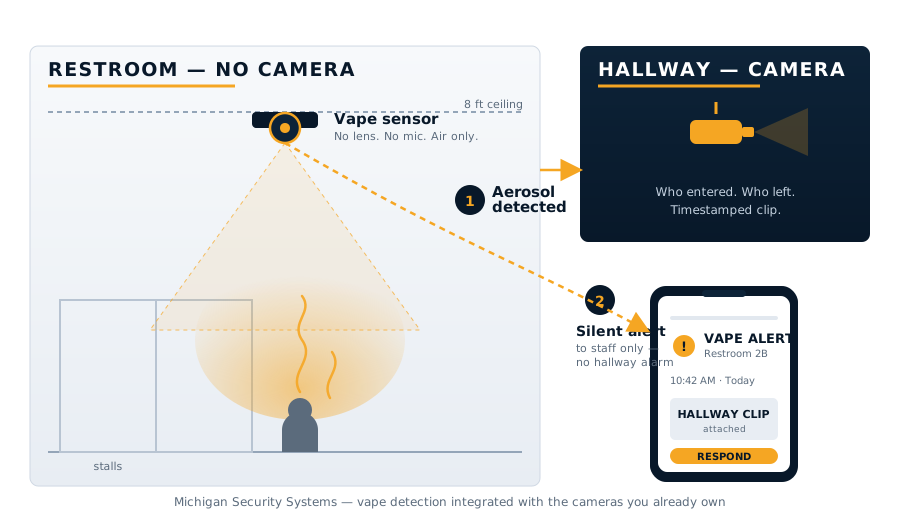
How it works. The sensor reads air chemistry inside the restroom — no lens, no microphone. The camera stays in the hallway, where it belongs, and captures who came and went. Staff get one silent alert with both pieces attached. No hallway alarm announcing the event to the entire school.
We're an integrator, not a single-line dealer. We'll spec the platform that fits your building, your network, and your budget — not the one we're contractually obligated to push.
| Platform | Best Fit | What It Detects | Power / Connection |
|---|---|---|---|
| HALO Smart Sensor (IPVideo) | Districts wanting one device to cover multiple threats; buildings pursuing safety-grant funding | Vape, THC, masking chemicals, air quality, VOCs, decibel/aggression levels, motion. No camera, no audio recording. | PoE — covers roughly 1,960 sq ft per sensor with 360° detection |
| Zeptive | Older buildings with no drop ceiling or conduit path; fast phased rollouts | Vape aerosol including nicotine and propylene glycol, THC, air quality, tamper. 15+ detection features. | Wireless/battery (cellular), USB+WiFi, or PoE — the only major line offering true wireless |
| Verkada | Campuses already standardized on Verkada cameras and access control | Vape Index (multi-sensor composite), THC, air quality, noise, occupancy | PoE, native to the Verkada cloud console |
| Triton 3D Sense / 3D Sense Pro | Single-purpose vape budgets (3D Sense) or full safety platform (Pro) | Vape, THC, plus expanded safety features on the Pro model | PoE |
| Soter FlySense | Cellular deployments where district IT won't open the network | Vape, THC, sound anomaly | Cellular or network |
An honest note on the “DIY” pitch. Several manufacturers market these as drill-five-holes, plug-and-play devices — and mechanically, that’s true. What isn’t DIY is the part that determines whether the system works: sensor placement against the room’s real airflow, mounting height, tamper resistance in a room full of teenagers, network and VLAN configuration, alert routing to the right staff, and integration with the cameras and doors you already have. That’s the difference between a sensor on a wall and a working program.
A bare alert says vaping happened in Restroom 2B at 10:42. That’s a starting point, not an answer. Because we install cameras and access control across Michigan every day, we can make the alert arrive with everything around it.
The sensor fires, and your Axis, Hanwha or Digital Watchdog camera outside the door delivers the clip of who entered and exited in that window. The privacy line holds — the lens never goes inside.
On PDK or CDVI controlled doors, the alert can be correlated with who badged into that wing. Useful in colleges, hospitals and workplaces where access is credentialed.
Silent notifications to the assistant principal's phone, the security office, or a staff distribution list — not a hallway alarm that broadcasts the event to the whole school and teaches students to game it.
We're a Bogen dealer. Where a district wants vape or aggression events tied into intercom, paging or emergency notification, that path already exists in our stack.
Location and time-of-day heat maps show whether the program is working. That data is what justifies phase two — and what a superintendent needs at the next board meeting.
Zero subcontractors. The technician who mounts the sensor works for us, the tech who commissions the network works for us, and the person who answers when it false-alarms in November works for us.
Most districts we talk to assume this comes out of general fund. In Michigan, it often doesn't have to — though not every program fits every district, and the strings matter. We're not grant writers, but we know what these programs ask for, and we build quotes that survive procurement.
Under MCL 388.1631aa, Michigan’s FY2025-26 school aid budget allocated $300 million from the School Aid Fund plus $21 million from the General Fund to support school safety and mental health, with per-pupil grants continuing into FY2026-27. Notably, the statute’s own definitions reference detection of vape substances — vaping is explicitly on Michigan’s school-safety radar.
Worth knowing: recent budget language ties 31aa acceptance to investigation and privilege-waiver provisions around a “mass casualty event,” and some Michigan districts have declined the funding on their attorneys’ advice. If your board has already passed on 31aa, that does not close the door — CSSGP and Title IV-A carry no such condition. We have quoted around this before.
Administered by the Michigan State Police Office of School Safety, the CSSGP funds security technology and equipment purchases — up to $50,000 per school and $250,000 per district. Multi-sensor platforms that detect more than vape alone tend to fit these criteria best.
Title IV-A student support allocations and SAMHSA substance-abuse prevention funding are commonly used for vape detection nationally. ESSER is gone — districts that were waiting on it need a different plan.
Security-equipment grants generally favor devices with capability beyond a single trigger — motion, sound/aggression detection, chemical and air quality sensing. A vape-only sensor may not qualify where a multi-sensor platform does. We'll tell you that before you write the spec, not after.
Local precedent: Plymouth-Canton Community Schools, in Metro Detroit, deployed HALO Smart Sensors specifically to detect vaping in areas where video surveillance would not be appropriate. Michigan districts are not experimenting with this technology — they’re standardizing on it.
We walk the building with your team and identify the actual problem rooms — not every restroom. Ceiling height, airflow, existing network drops and tamper exposure all get recorded. Most districts need far fewer sensors than they think, placed far more deliberately.
Wireless or PoE, vape-only or multi-threat, based on your building and your funding source. You get a real count and a real number — not a per-unit price multiplied by every restroom on the floor plan.
We work with your IT director on VLAN, PoE budget and console access before a single anchor goes in the ceiling. We define who gets alerted, how, and what happens next. This step is where most failed deployments actually failed.
Mounted, cabled, configured and labeled by MSS employees. Summer and after-hours scheduling for occupied school buildings is standard for us.
Sensitivity gets tuned to the real room. Aerosol readings can rise from things that aren't a vape pen — steam, cleaning chemicals, fumes. Tuning that out in the first weeks is what keeps staff trusting the alerts in month six.
Your administrators learn the console, the app and the reporting. Then we stay on the other end of the phone — same company, same number, for the life of the system.
Why placement is the whole job.
Schools drive most of the volume, but any facility with a smoke-free policy and a restroom has the same enforcement gap.
Smoke-free campus enforcement in patient and staff restrooms, plus air quality monitoring in sensitive areas.
Break rooms, locker areas and restrooms in facilities where combustibles or clean-process requirements make vaping a genuine safety issue, not just a policy one.
Non-smoking room enforcement and common-area monitoring, with documentation that supports the cleaning fee.
Public buildings, libraries and courthouses with smoke-free ordinances to enforce and no practical way to staff it.
Resident-safety and fire-risk monitoring in private rooms and common areas where cameras are inappropriate.
Consumption-control and compliance monitoring in licensed environments where on-site use rules are strictly enforced.
Headquartered in Mount Clemens with branch offices in Wixom and Milford — serving school districts, hospitals and employers throughout Michigan, Ohio and Indiana.
Looking for a commercial vape detection installer near you in Michigan? Michigan Security Systems installs and services school vape detection systems and vape sensors for districts, colleges, hospitals, and workplaces across Metro Detroit, Ann Arbor, Lansing, Flint, Grand Rapids, and the communities of Macomb, Oakland, and Wayne counties — installed by our own licensed Michigan technicians, never subcontractors.
Sterling Heights, Warren, Clinton Township, Shelby Township, Chesterfield, New Baltimore, Romeo, Utica, Mount Clemens and surrounding districts.
Troy, Novi, Southfield, Rochester Hills, Farmington Hills, Royal Oak, Auburn Hills, Pontiac, Milford, Wixom and surrounding districts.
Detroit, Livonia, Dearborn, Canton, Plymouth, Westland, Taylor, Northville and surrounding districts.
Most integrators your district calls will subcontract the install. You’ll get a company name on the quote and a stranger on the roof — and when the sensor false-alarms in November, you’ll find out that company doesn’t employ the person who mounted it.
We don’t work that way, and we never have. The technician who walks your building, the one who mounts and commissions the sensors, and the one who picks up when you call in month six all have Michigan Security Systems on their paycheck. That’s been the rule here since 2000.
It’s also why we schedule school work around your building — summers, evenings, and breaks — rather than around a subcontractor’s availability.

Our own crew, our own truck. On site at a Michigan school — the same crew that handles your cameras, access control and vape detection.
Tell us the building and the problem rooms. We'll walk it, give you an honest sensor count and a quote your business office can put against a grant — and if vape detection isn't the right spend for you right now, we'll say that too.
Michigan Security Systems — Mount Clemens · Wixom · Milford — Serving Michigan, Ohio & Indiana since 2000
We install vape and threat-detection sensors in the areas that need them most:
Fill out the form below and a Michigan Security Systems specialist will contact you within one business day to schedule your free, no-obligation site assessment for your school or facility.
Michigan Security Systems · 586-466-4490
Macomb County, Michigan
Wixom, MI · Milford, MI
Michigan · Ohio · Indiana
Mon–Sat: 8:00 AM–7:00 PM
24-Hr Emergency: 1-800-941-6797